International vs. Global Business… What’s the Real Difference? (It’s Not What You Think)
"We are a global company." You hear this in every boardroom, in every pitch deck, and in every marketing campaign.
But pause for a second. Is "Global" just a fancy word for "International"? Most people use them interchangeably. But in business science, they are two completely different planets.
Before we dive in: If you like breaking down complex business theories into simple, usable ideas, take a look at the other articles on my site. I cut through the jargon so you don’t have to.
Now, back to the main point. Here is the twist: The difference isn’t about how many countries you are in. It is about how you run your business across those countries.
You can be international without being global. And being global isn't just "being big." It’s a specific mindset.
Here is how to tell them apart.
1. International Business: The "Chameleon" Strategy
When academics talk about International Business, they describe a specific way of looking at borders.
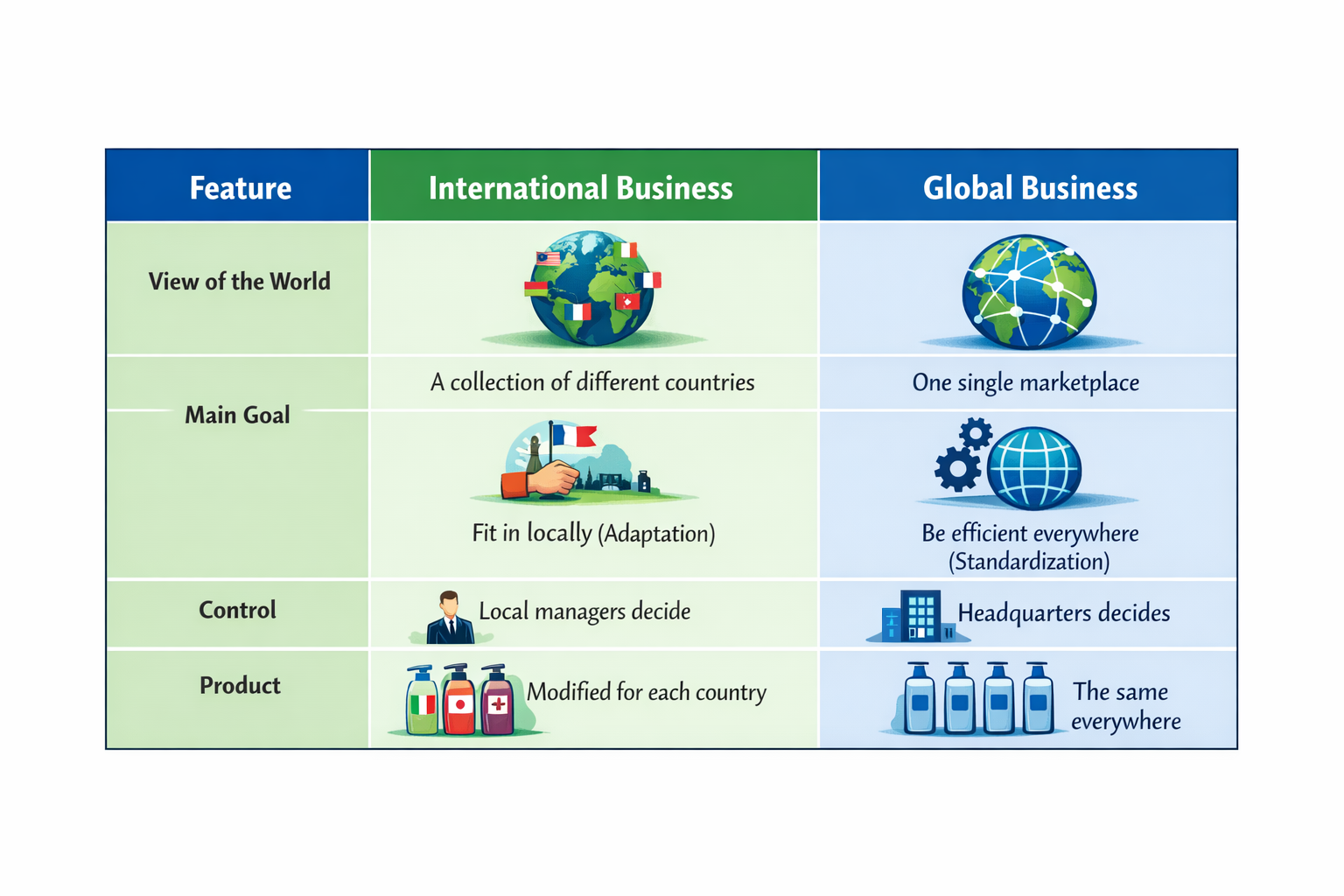
In this model, the world is a collection of separate, unique playgrounds. France is different from Brazil. Japan is different from Canada. An "International" company acts like a chameleon. It enters a new country and… it adapts.
The Product: You change it to fit local tastes.
The Marketing: You create new campaigns that speak the local language (literally and culturally).
The Strategy: Local managers have a lot of freedom because they know their backyard best.
The Logic: You treat each country as a separate project. You want to be "local" everywhere.
Think of it this way: A shoe brand that sells heavy boots in Norway but focuses on light sandals in Australia. They adapt. That is International.
2. Global Business: The "One World" Strategy
Global Business is a different beast entirely. Here, borders are just lines on a map. They don't dictate the product.
A global company assumes that people, deep down, want the same things. Instead of adapting to every single country, they look for the common denominator.
The Product: It is standardized. You get the exact same thing in New York, Warsaw, and Tokyo.
The Marketing: One consistent message. One brand image.
The Strategy: Decisions are made at the top. The goal isn't to be "local"—the goal is to be efficient.
The Logic: You treat the world as one single, giant market. You want scale, speed, and consistency.
Think of it this way: An iPhone. It doesn't matter where you buy it. The hardware is the same, the software is the same, and the experience is the same. That is Global.
The Cheat Sheet
If you are ever confused, just look at how the company behaves:
thekindconcrete.com
Why This Matters
This isn't just vocabulary. It is about where you spend your money.
If you choose the International path, you win by being close to the customer. You are "one of them." But it’s expensive because you have to reinvent the wheel for every country.
If you choose the Global path, you win on price and technology because you have massive scale. But you risk being a soulless corporation that doesn't understand local culture.
You can't be both at the same time. You have to pick your battle.
What Comes Next?
So, we have "International" (Adaptation) and "Global" (Standardization). But is there a middle ground? Is there a "Holy Grail" strategy that combines the flexibility of a chameleon with the power of a giant?
Actually, yes. There are two more strategies: Multidomestic and Transnational. One of them is the gold standard for modern business, but it is incredibly hard to pull off.
I will break them down in someday.
Want to be the first to read it? Join the Telegram channel linked at the top of this page.
(If you have questions about your specific strategy, or just want to say hi, feel free to send me a direct message!)